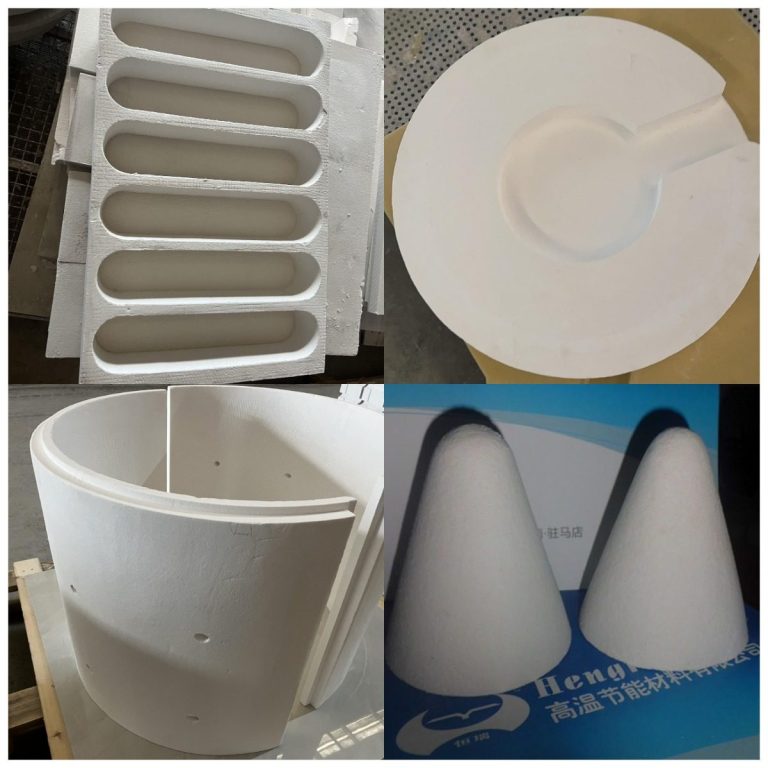
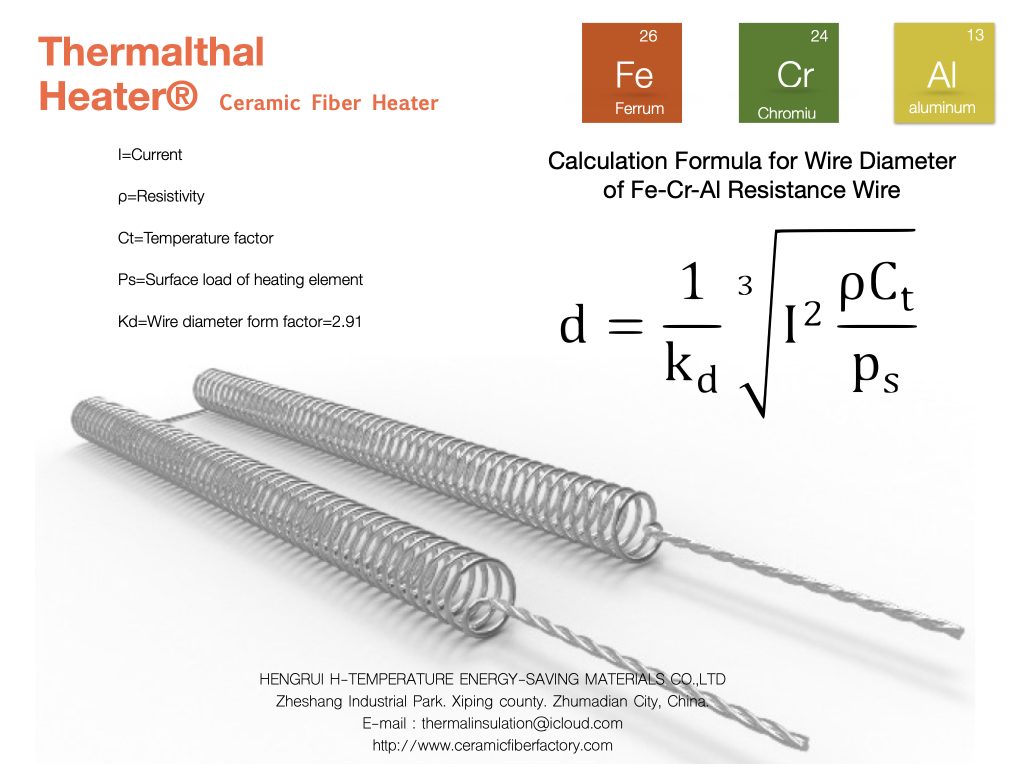
FeCrAl resistance wire is widely used in ceramic fiber heaters because of its excellent high-temperature oxidation resistance, stable electrical properties, and good compatibility with lightweight refractory insulation. For ceramic fiber heaters designed to operate at around 1100°C, selecting the correct wire diameter is one of the most important steps in heater design.
If the wire diameter is too small, the heating element may overheat, oxidize quickly, or fail prematurely. If the wire diameter is too large, the heater may become slow to heat, difficult to install, or unable to match the required electrical resistance. Therefore, a scientific calculation method is needed to balance power, voltage, resistance, surface load, and operating temperature.
1. Basic Parameters Needed Before Calculation
Before calculating the FeCrAl resistance wire diameter, several design parameters should be confirmed:
- Rated voltage: V
- Required power: W
- Working temperature: °C
- Heater size and available installation space
- Wire arrangement method
- Resistance wire material grade
- Allowable surface load
- Required service life
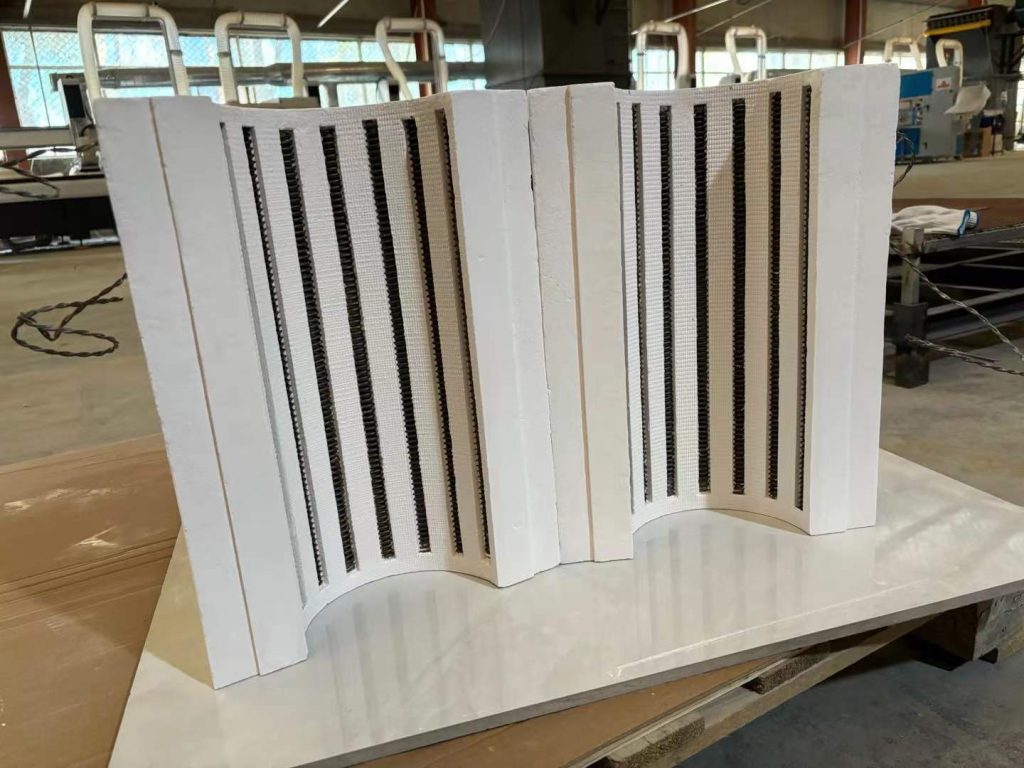
For ceramic fiber heaters used at 1100°C, the wire is usually installed in grooves, embedded into ceramic fiber modules, or fixed on the heating surface. The structure must allow enough heat radiation and prevent local overheating.
2. Calculate the Required Electrical Resistance
The first step is to calculate the total resistance of the heating element.
The formula is:
R = V² / PWhere:
R = required resistance, ohm
V = rated voltage, volts
P = rated power, watts
3. Choose the Correct FeCrAl Alloy Grade
Different FeCrAl grades have different resistivity and maximum working temperatures. Common FeCrAl resistance wire grades include:
| Material Grade | Typical Resistivity | Common Application |
|---|---|---|
| KANTHAL A-1 | approx. 1.45 ohm·mm²/m | Industrial heaters, medium-high temperature |
| 0Cr21Al6Nb | approx. 1.45 ohm·mm²/m | High-temperature furnace elements |
| 0Cr27Al7Mo2 | approx. 1.53 ohm·mm²/m | Higher temperature and longer life applications |
For ceramic fiber heaters operating at 1100°C, high-quality FeCrAl alloys with good oxidation resistance are recommended. The exact grade should be selected according to working temperature, atmosphere, heating cycle, and expected service life.
4. Example Calculation
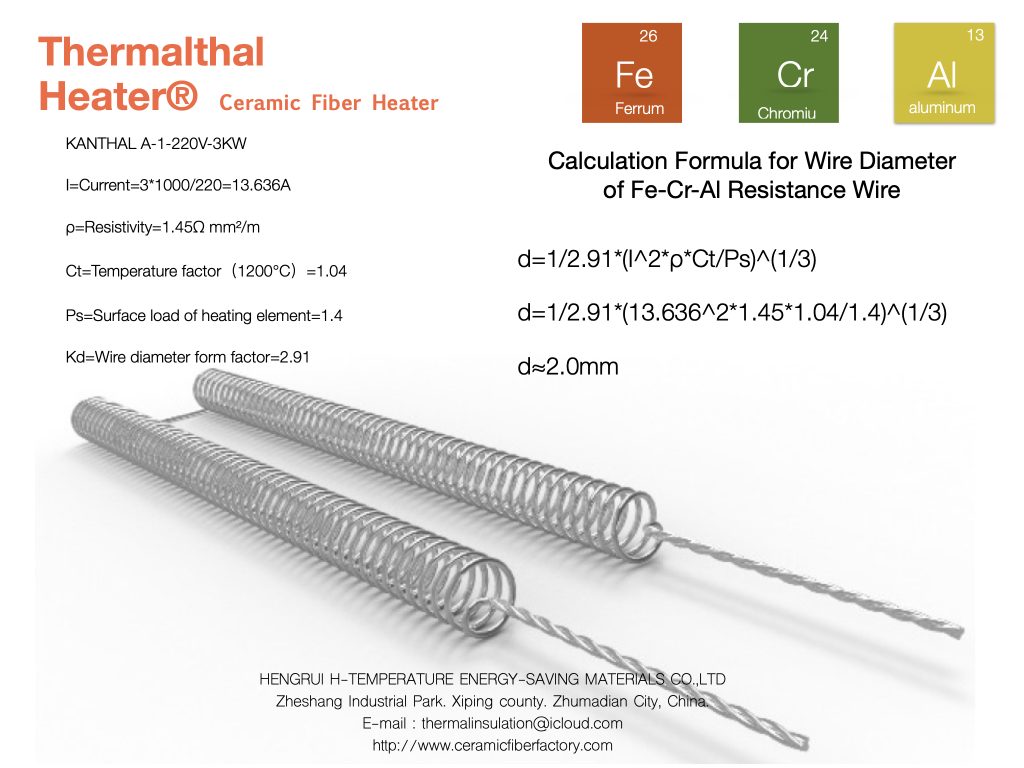
Therefore, wire diameter calculation should not be treated as a single mathematical step. It should be combined with actual heater structure design and thermal engineering experience.
5. Practical Design Tips for 1100°C Ceramic Fiber Heaters
For ceramic fiber heaters working at 1100°C, the following recommendations are useful:
- Use FeCrAl wire with suitable high-temperature oxidation resistance
- Avoid too small wire diameter for long-term operation
- Keep surface load within a safe design range
- Ensure uniform coil spacing to prevent hot spots
- Avoid sharp bending of resistance wire
- Leave enough space for thermal expansion
- Use suitable ceramic fiber density and thickness
- Test resistance value before and after installation
These steps help improve heater stability, temperature uniformity, and service life.
Conclusion
Calculating FeCrAl resistance wire diameter is a key part of designing ceramic fiber heaters for 1100°C industrial applications. The basic calculation starts from voltage, power, resistance, resistivity, wire length, and cross-sectional area. However, a reliable heater design must also consider surface load, installation structure, thermal expansion, oxidation resistance, and working environment.
By combining scientific calculation with practical engineering design, FeCrAl ceramic fiber heaters can provide fast heating, high efficiency, stable performance, and long service life.
If you need customized ceramic fiber heaters with FeCrAl resistance wire for 1100°C applications, our engineering team can help calculate wire diameter, power density, heater size, and installation structure according to your specific furnace or heating equipment requirements.