A Complete Worked Example with KANTHAL A-1
Need a custom furnace coil or replacement resistance wire? Request a free engineering quote →
Why Correct Resistance Wire Length Matters
Whether you are rebuilding a box furnace, designing a radiant tube heater, or replacing a broken hearth element, getting the resistance wire length wrong is one of the most common — and most costly — mistakes in electric furnace construction.
Too short, and the wire overdraws current, overheats, and burns out in days. Too long, and the element cannot reach setpoint, wastes energy, and underperforms.
In this guide, we walk through the full design calculation using a real-world specification — KANTHAL A-1, 220 V, 3 kW — and show exactly how to arrive at the correct wire diameter and total heated length. We also explain how our engineered furnace heating elements are manufactured to these exact tolerances.
| Parameter | Symbol | Value | Unit |
| Rated power | P | 3,000 | W |
| Supply voltage | U | 220 | V |
| Resistivity at 20 °C | ρ₂₀ | 1.45 | Ω·mm²/m |
| Operating temperature | T | 1,200 | °C |
| Temperature correction factor | Ct | 1.04 | — |
| Recommended surface load | w | 1.4 | W/mm² |
| Wire material | — | KANTHAL A-1 | FeCrAl alloy |
Note on surface load (w): For open-coil elements operating at 1,200 °C in air, a surface load of approximately 1.4 W/mm² is a well-established design target from KANTHAL’s engineering handbook. Pushing higher shortens element life dramatically.
tep 1 — Calculate Operating Current
The current drawn by the element at rated power:
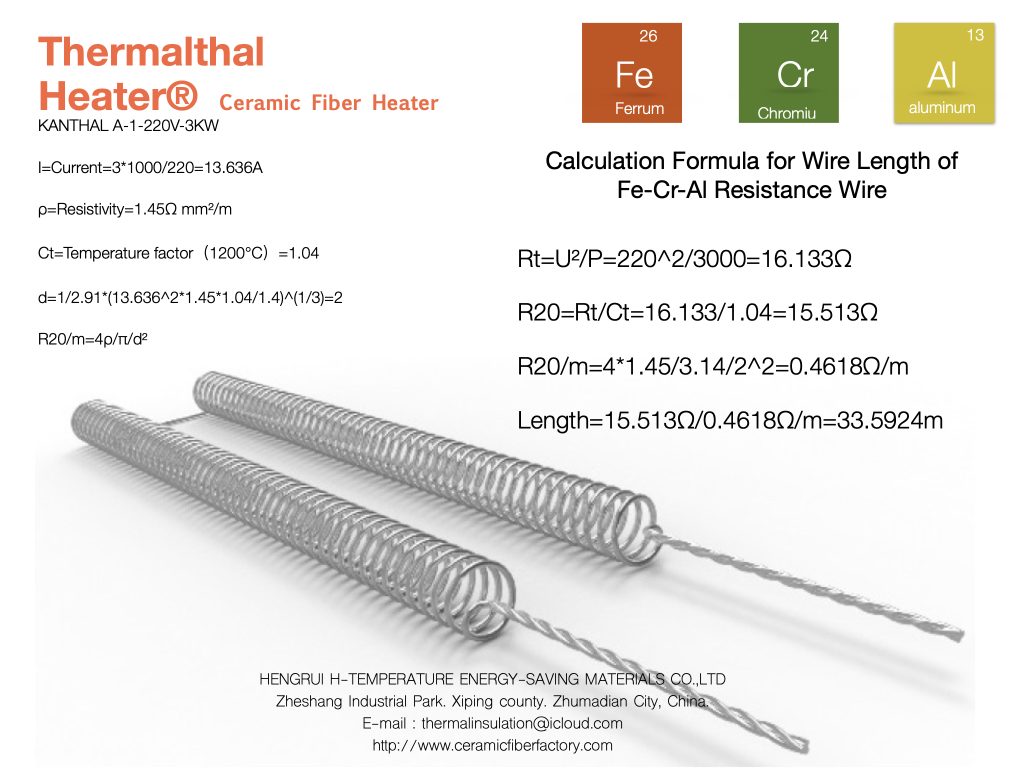
I = P / U = (3 × 1000) / 220 = 13.636 A
This value determines the minimum conductor cross-section and must also be matched to your contactor, fuse, and wiring gauge.
Step 2 — Select Wire Diameter
The diameter of a round FeCrAl wire is chosen so that its surface area can dissipate the required heat without exceeding the recommended surface load. The KANTHAL empirical formula for wire diameter is:
d = (1 / 2.91) · ³√( I² · ρ₂₀ · Ct / w )
Substituting our values:
d = (1 / 2.91) · ³√( 13.636² × 1.45 × 1.04 / 1.4 )
d = (1 / 2.91) × 5.851 = 2.01 mm
We round up to the nearest standard wire gauge: d = 2.00 mm.
Step 3 — Calculate Total Hot Resistance
At operating temperature, the element must present the exact resistance needed to dissipate 3 kW at 220 V:
Rt = U² / P = 220² / 3000 = 48,400 / 3000 = 16.133 Ω
This is the hot resistance at 1,200 °C.
Step 4 — Convert to Cold Resistance (20 °C)
Because KANTHAL A-1 resistance changes with temperature, we correct back to 20 °C using the temperature factor Ct = 1.04:
R20 = Rt / Ct = 16.133 / 1.04 = 15.513 Ω
Step 5 — Resistance per Meter
For a round wire of diameter d:
R20/m = 4 · ρ₂₀ / (π · d²)
R20/m = (4 × 1.45) / (3.1416 × 2.00²) = 5.8 / 12.566 = 0.4616 Ω/m
Step 6 — Calculate Total Wire Length
Finally, divide the required cold resistance by the resistance per meter:
L = R20 / R20/m = 15.513 / 0.4616 = 33.59 meters
Design Result Summary
| Result | Value |
| Wire material | KANTHAL A-1 |
| Wire diameter | 2.00 mm |
| Total heated length | 33.59 m |
| Operating current | 13.64 A |
| Hot resistance | 16.13 Ω |
| Surface load | 1.4 W/mm² |
| Max. continuous temperature | 1,200 °C |
Why 33.59 Meters of Wire Is Never Just "33.59 Meters"
On paper, 33.59 m sounds straightforward. In a real furnace, that length must be wound into coils, supported on ceramic hooks, spaced to avoid shorts, and terminated with cold ends. The actual installation requires:
- Coil pitch and inner diameter — must be designed so adjacent turns do not touch and thermal expansion does not buckle the element.
- Cold ends — a heavier gauge or water-cooled section at the terminals to prevent terminal overheating.
- Support hardware — ceramic beads, hooks, or saddles rated for 1,200 °C.
- Hearth geometry — the coil must fit the chamber dimensions without cold spots or hot streaks.
This is where an off-the-shelf replacement wire often fails: the math may be correct on a calculator, but the physical element does not survive the thermal cycling of a production furnace.
Our Engineered Furnace Heating Elements
At [Your Brand / Company Name], every resistance wire furnace element is built from verified FeCrAl (KANTHAL A-1 / APM) or NiCr (80/20) alloy and manufactured to the exact length, diameter, and coil geometry derived from your voltage, wattage, and chamber dimensions.
What we supply
- Custom wound heating coils for box furnaces, pit furnaces, tunnel kilns, and radiant tubes
- KANTHAL A-1, APM, and NiCr 80/20 wire in gauges from 0.4 mm to 8.0 mm
- Pre-formed coil elements with ceramic supports and terminal cold ends
- Replacement hearth elements for heat treatment, brazing, sintering, and glass work
- Engineering drawings and resistance verification certificates for every batch
Why buyers choose us
- Every element is resistance-tested before dispatch — we measure cold resistance and compare it to your calculated R20 to ±2 %.
- We use genuine KANTHAL and equivalent OEM alloy, not recycled or re-drawn substitute wire with inconsistent resistivity.
- We account for thermal expansion, coil pitch, and hearth geometry — not just the calculator length.
- Fast turnaround — standard designs ship within 5–7 working days.
Frequently Asked Questions
Can I use this formula for NiCr (80/20) wire?
The method is the same, but use the correct ρ₂₀ (≈ 1.09 Ω·mm²/m for NiCr 80/20) and a lower recommended surface load at high temperature. NiCr typically runs at 1.0–1.2 W/mm² above 1,000 °C.
What if my furnace runs at 380 V three-phase?
For a three-phase delta or star configuration, calculate the line-to-neutral voltage per element first, then apply the same single-phase formula for each branch. Contact us with your schematic and we will size the elements for you.
How do I know if surface load is too high?
If your element life is shorter than 2,000 hours in air at rated temperature, the surface load is likely above the recommended value. We can reverse-engineer your existing coil and redesign it with a safer load.
Ready to Order a Custom Furnace Element?
Send us your voltage, wattage, chamber size, and operating temperature, and we will return a free calculation sheet and quotation — including the exact wire length, diameter, coil geometry, and support arrangement.
Get Your Free Custom Heating Element Quote →
Include: voltage (V), power (kW), furnace type, chamber dimensions (mm), and max operating temperature (°C).
Keywords: resistance wire calculation, KANTHAL A-1 heating element, furnace coil length formula, electric furnace wire sizing, FeCrAl resistance wire, custom hearth elements, replacement furnace heating coil, surface load W/mm².